
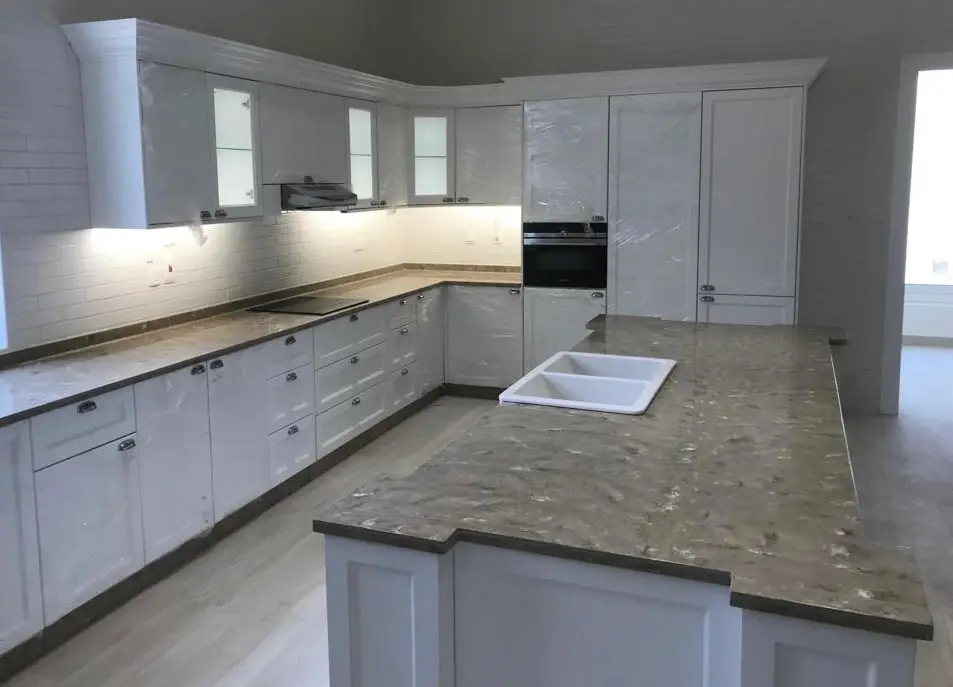
Imagine your dream kitchen: a beautiful, durable counter that handles everything life throws at it. For many, that dream is a genuine solid surface top, often called Corian. But when it’s time to buy, a question pops up: is this the real thing?
Don’t worry. Identifying an authentic Corian kitchen top is easier than you think.
Look for a smooth blend:
A major sign of a genuine top is its seams. A trained installer can join pieces together so well the seam almost disappears. You should not feel a sharp ridge or a visible gap where two pieces meet. Run your hand over the surface. It should feel smooth and continuous, with no bumps or dips at the joints.
Feel the warm, solid texture:
Do not just look with your eyes; use your hands. Press your fingernail into the surface in a hidden spot, like inside a sink bowl or on a cut-out piece. Genuine material feels solid and slightly warm, not cold and hard like stone. It should not chip or scratch easily from this simple test. It has a dense, non-porous feel.
Check for integrated sink bowls:
Many genuine tops have the sink bowl made from the same piece of material. This is called an integrated sink. There is no metal rim or line where a separate sink has been dropped in. The whole area is one smooth, continuous surface, which makes cleaning very easy.
See if it has a consistent pattern:
Look closely at the color and pattern. In a genuine top, the color and any flecks or patterns are consistent all the way through the material. If you see a printed-on top layer or a pattern that looks like a thin sticker, it is likely an imitation. A small sandpaper scratch in a hidden area will show the same color underneath.
Ask for the documentation:
A reputable supplier will always have proof. They should be able to show you a sample of the material with its name and color code. They should also provide a warranty certificate from the manufacturer. This paperwork is your best guarantee that you are getting an authentic product.
Notice its repairability:
A great quality of this material is that small scratches or stains can be fixed. A trained professional can sand out minor damage, making the top look new again. Ask your installer to demonstrate this on a sample piece. If the material cannot be easily sanded smooth, it might not be the real thing.